
Address : 94-11, Bunhwang-ro, Gyeongju-si / 경북 경주시 분황로 94-11

Not far from the center of Gyeongju lies a temple that changes its colors with the wind.
Bunhwangsa Temple, one of the oldest stone temples in Korea, isn’t grand or crowded — it’s quiet, almost shy.
But when spring and autumn arrive, the temple turns into a living painting.
Spring — Green Waves Beneath an Ancient Pagoda

In late April and May, the fields around Bunhwangsa shimmer with fresh green barley (cheongbori).
The young barley sways like ripples in the wind, and the ancient Bunhwangsa Stone Pagoda rises calmly in the background — a contrast of eternity and renewal.

But that’s not all — scattered among the barley are soft clusters of yellow canola flowers, glowing under the sun like drops of light.
Together they create one of Gyeongju’s most peaceful spring landscapes: green waves touched with gold, stretching all the way to the temple’s stone walls.

Locals often visit here for quiet walks or to take photographs of the wind moving through the fields.
When the breeze passes, the barley and canola sway together —
two colors, two textures, blending into one calm rhythm of spring.

when is the best time visit in Spring?
Best time: Late afternoon, around 4:30–6:00 p.m.
The low golden sunlight hits the barley and canola fields sideways, making the green and yellow tones glow softly.
The temple’s stone pagoda catches the warm light, and shadows stretch gently across the field — perfect for photos and slow walks.
Early Autumn — Fields of Cosmos and Zinnia

When the summer heat fades, Bunhwangsa changes again.
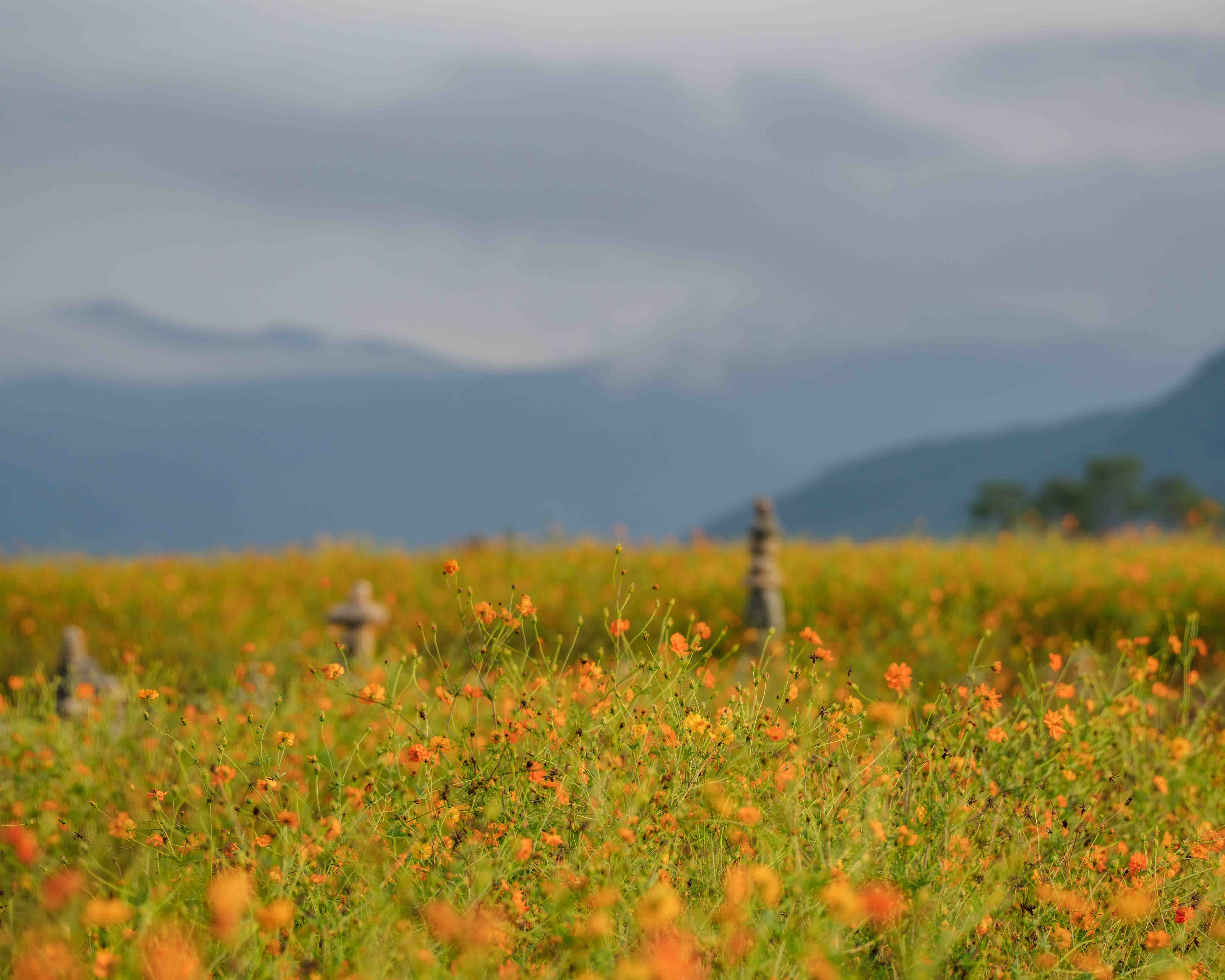
From late August to early October, the barley field transforms into a sea of yellow cosmos (hwanghwa kosmos) and pink-red zinnias (baegilhong).

The bright flowers spill across the field like a woven Korean tapestry, and bees float lazily between the blossoms.
In the distance, the temple’s pagoda stands quietly — timeless against a horizon filled with color.
If you come during golden hour, the sunlight filters through the petals, making the flowers almost translucent.

It’s a scene that feels both vibrant and peaceful — a reminder that even ancient places can bloom anew every year.

when is the best time to visit in autumn?
est time: Early morning (8:00–9:30 a.m.) or Golden hour (5:00–6:00 p.m.)
- In the morning, the flowers stand fresh, upright, and the colors look crisp under soft light. The air is cool and quiet, ideal for photos without crowds.
- In the late afternoon, the sun filters through the cosmos petals, creating a dreamy glow. The orange and pink hues look especially vivid against the gray stone pagoda
After you’ve wandered through the fields of flowers or green barley, step inside the temple grounds — you’ll immediately notice the quiet dignity of the Bunhwangsa Stone Pagoda rising at the center.
Built in 634 CE, during the reign of Queen Seondeok, this is the oldest surviving stone pagoda in Korea.

Unlike most pagodas carved from stacked blocks, it was constructed with cut bricks of black stone,
giving it a distinctive square shape and a texture that looks both fragile and eternal.
Originally, the pagoda had nine stories, though only three remain today.

Still, standing before it feels like touching the beginning of Korean Buddhist architecture —
a moment when faith and craftsmanship first met in stone.
The pagoda’s name, Bunhwangsa Samcheung Seoktap, literally means
“Three-storied Stone Pagoda of Bunhwangsa Temple,”
and it is designated as National Treasure No. 30.
Inside, relics and miniature pagodas were once enshrined, symbolizing prayers for peace and protection of the Silla kingdom.
Tips
Hours: 9:00 a.m. – 5:00 p.m.
Admission: Free
Roughly 20 minutes walk from Donggung Palace & Wolji Pond
Leave a Reply